
The restaurant’s owner examines the sales and then the bottom line prior to closing the report.
Sound familiar?
It could be an amazingly precise report, but just by examining two figures, you leave the bulk of its value on the table.
A good bookkeeping system for restaurants shouldn’t make proprietors more dependent on their accountant. It should make them more confident in their own numbers. You don’t need to know all accounting rules or be a slave to invoices for hours. You should know how profit has changed as well as what’s changed with food and labor costs, and what questions should be addressed in the coming week.
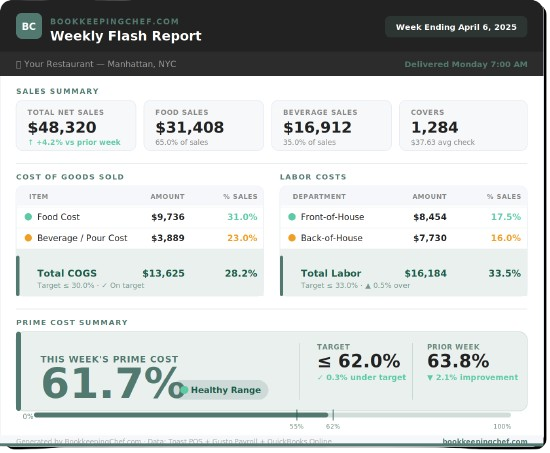
That’s the philosophy behind Bookkeeping Chef: automate the bookkeeping work that doesn’t need an owner’s time while giving restaurant operators clearer financial information they can actually use.
Don’t stop at month-end Numbers. Start by calculating Weekly Numbers
Restaurants don’t run on an annual basis. The managers this week plan their work. The chef has ordered food for today. Vendors change prices now.
This is why Bookkeeping Chef provides weekly prime-cost flash reports alongside monthly financial statements.
Prime cost brings together cost of goods sold and labor. These are two main areas that can move quickly in restaurants. The bookkeeping chef’s provided information states that prime costs typically represent approximately 60% of the sales at restaurants.
Imagine that sales barely grew, yet the cost of production increased. This percentage does not provide an answer. It gives the owner an incentive to look into the issue.
Has the hourly wage increased? Did overtime occur? Did the price of food changed? A vendor invoice seemed unusually large? Did sales mix changes?
It’s better to find out about the issue earlier rather before it gets worse.
Automate the repetitive Work
DIY bookkeeping does not need to be a manual process of transferring POS (point of sale) totals onto spreadsheets.
Automating restaurant bookkeeping can help to reduce the number of times financial data is moved. This service can be connected to POS systems such as QuickBooks, QuickBooks, vendor platforms as well as recipe management and inventory management as well as AP/payment instruments.
Automation isn’t the only goal.
This is done to reduce the time spent on manual data entry. Also, it keeps the financial records up-to-date so that owners can focus on studying data, not gathering it.
It’s a totally new accounting model for restaurants. Technology takes care of the mechanical aspects and the proprietor remains involved in the financial side.
Learn to ask the P&L Better Questions
Stop thinking of your P&L as if it were an accounting test.
Start with sales. Start with sales. Compare the performance of beverages and food. Take a look at the labor. See the work.
The importance of comparing periods.
If profits increased but sales grew, but profit was not, something between the two lines was changed. If the cost of food increased, ask what happened operationally. Review the staffing numbers and sales activities in case labor percentages have changed. If the number appears odd, investigate rather than assuming the restaurant was simply having an unlucky month.
Bookkeeping Chef provides monthly P&Ls that are completed in five business days. This provides owners the chance to examine recent results rather than receive financial statements for a long time after the period of operation has passed.
For owners searching bookkeeping restaurant solutions, speed is useful but understanding is the bigger objective.
DIY Doesn’t Have to Mean doing everything yourself.
You don’t have to become your own full-time bookkeeper to avoid handing over the whole financial responsibility over to another person.
You can be involved as a business owner without performing all accounting tasks manually.
This could mean making use of automated systems to manage information flow, checking an annual P&L and a weekly report on prime costs, or asking questions if something unexpected occurs.
The specialization in restaurant bookkeeping can assist in this way by maintaining the books in order and helping the restaurant owner understand what they mean.
However, this does not mean the bookkeeper is capable of performing all bookkeeping functions.
Owners who are able to be able to sit down and discuss intelligently about their business and the P&L will be more successful.
The objective of financial freedom is not to generate more reports, but rather to be able to live a life of financial freedom.
Restaurants already generate enormous quantities of data. A dashboard may not always make sense.
The real value comes when an operator is able to open a P&L report, and see that there has been a change, and then go through the prime-cost reports.
Bookkeeping Chef’s approach is a combination of financial support for restaurants daily reporting, and automated bookkeeping in restaurants to achieve this.
Automate repetitive tasks. Review prime cost every week. Learn to understand the same language as your P&L.
You don’t need to be a professional accountant.
You should be an owner who is aware of the financial story behind your own restaurant.